Key Takeaways
- Moving equipment across thresholds, joints, debris, and uneven floors can transmit shock into the cart, payload, and operator.
- R.T. Laird, Inc. designs suspension caster systems for applications where standard casters may not provide enough shock isolation.
- Correct caster selection depends on load, floor conditions, travel speed, wheel requirements, mounting style, and the sensitivity of the equipment being moved.
- Application-specific engineering input is especially important for high-value, fragile, heavy, or frequently moved equipment.
Why Caster Selection Matters Beyond Basic Mobility
Casters do more than make carts, racks, fixtures, and mobile equipment easier to move. They also influence how much impact, vibration, noise, and rolling stress travels from the floor into the equipment above them. For organizations transporting sensitive instruments, finished products, aerospace components, food-service equipment, tooling, or other valuable loads, those details can affect daily operations.
R.T. Laird, Inc. addresses these challenges with shock absorbing suspension casters designed to help isolate equipment and payloads from harsh floor conditions. Instead of treating a caster as a simple wheel and bracket, the company focuses on the relationship between the floor, wheel, suspension system, equipment frame, and carried load.
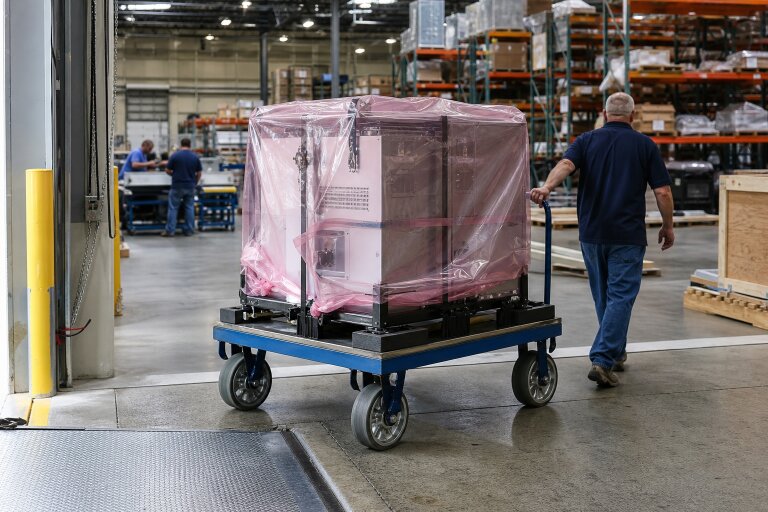
A standard caster may perform well on smooth, level floors at moderate speeds. However, when equipment repeatedly crosses expansion joints, dock transitions, door thresholds, cracked concrete, ramps, or debris, sudden impacts can travel through the caster assembly. That transfer may contribute to noise, wheel wear, equipment stress, unstable loads, and discomfort for people who push or operate the equipment.
The right solution is not the same for every cart or vehicle. Load range, the number of casters supporting the unit, center of gravity, route conditions, wheel material, travel frequency, and desired overall height all influence the final selection. A suspension caster should be evaluated as part of the complete mobile-equipment system.
How R.T. Laird, Inc. Suspension Casters Address Shock
R.T. Laird, Inc. uses spring-loaded suspension designs intended to provide a more gradual response as the caster encounters changing surfaces. The purpose is to absorb part of the movement before it reaches the frame and payload, rather than allowing every impact to pass directly through a rigid wheel-and-fork arrangement.
The company explains that conventional casters with limited spring deflection can develop high initial and final spring rates, particularly when they encounter uneven surfaces. By comparison, R.T. Laird, Inc. promotes a wider deflection range in its shock-isolating designs. In practical terms, that means the caster has more opportunity to respond to a bump, transition, or surface irregularity during travel.
Important Design Factors
- Spring deflection: Adequate deflection helps the suspension respond to changes in the travel surface.
- Load range: A caster must be sized for both the stationary weight and the forces created while the equipment is moving.
- Wheel selection: Wheel diameter and tread material affect rolling resistance, interaction with the floor, noise, durability, and suitability for the operating environment.
- Floor conditions: Rough concrete, floor joints, ramps, and thresholds often create the impacts that make suspension valuable.
- Equipment configuration: Mounting locations, load distribution, and center of gravity can change how each caster performs.
Why Uneven Floors and Repeated Impacts Deserve Attention
Floor quality is a material-handling concern, not merely a housekeeping issue. In its guidance for warehousing operations, OSHA identifies whole-body vibration from uneven floors and dock shock from uneven transitions as hazards associated with powered industrial truck work. The same basic principle applies to mobile equipment, carts, and fixtures that repeatedly travel across imperfect surfaces.
For fragile or high-value payloads, a brief impact can matter even when the cart remains upright and mobile. Vibration can affect sensitive assemblies, loosen connections, contribute to component movement, and create unwanted rattling or noise. A caster system that better manages those impacts may support smoother movement and reduce exposure to avoidable jolts.
Potential Benefits of an Application-Matched Suspension Caster
R.T. Laird, Inc. reports that its suspension caster systems can reduce shock and vibration by up to 80 percent and noise by up to 25 decibels in appropriate applications. Actual performance depends on the equipment, load, route, wheel selection, speed, and operating conditions, so those figures should be treated as application-dependent rather than universal results.
- Reduced transmission of shock and vibration into the equipment frame and payload.
- Lower noise from repeated impacts at joints, thresholds, and other surface transitions.
- Potentially less stress on wheels, bearings, caster components, and mobile equipment structures.
- Improved protection for delicate products, instruments, assemblies, and tooling.
- Smoother travel for employees who push, guide, load, or operate mobile equipment.
- Less potential for repeated impact-related floor marking or wear in demanding routes.
Where R.T. Laird, Inc. Casters Can Be Used
Suspension casters can be useful wherever a load must move safely over less-than-perfect surfaces. R.T. Laird, Inc. serves applications that include aviation, aerospace, food service, computer-related operations, industrial manufacturing, institutional environments, and specialized commercial equipment.
In aerospace and aviation settings, the focus may be on moving engines, assemblies, tooling, or support equipment with better control. In food-service environments, smoother rolling can be valuable for carts and equipment that travel across busy commercial floors. Manufacturing teams may need to protect parts, fixtures, and work-in-process materials during plant-floor transport. Medical and institutional facilities may prioritize quieter movement and reduced jolting around sensitive equipment.
How to Prepare a Shock Absorbing Suspension Casters Request
A productive discussion with R.T. Laird, Inc. starts with operating details. Selecting a caster based only on wheel diameter or a static capacity rating can overlook the dynamic forces created by movement. Buyers should provide enough information to evaluate the complete application.
- State the total equipment weight, maximum payload, and expected load distribution.
- Specify the number of casters and whether each position will carry an equal share of the load.
- Describe floor material, cracks, joints, thresholds, ramps, dock plates, and rough route segments.
- Identify how often the equipment moves, how far it travels, and how quickly it is normally moved.
- Share photographs, drawings, mounting dimensions, and desired overall equipment height.
- Note requirements for swivel or rigid casters, brakes, locks, wheel material, washdown resistance, or chemical exposure.
- Explain whether the main objective is payload protection, noise reduction, vibration control, wheel life, or operator comfort.
Why Operator Comfort Is Part of the Conversation
Research from NIOSH indicates that equipment movement impacts both people and products, with road surface conditions affecting whole-body vibration, where smoother surfaces yield lower exposure. While carts and industrial equipment differ from buses, it underscores the need for vibration control at both equipment and route levels. A suspension caster, alongside maintenance, training, and proper route planning, serves as an important engineering control to mitigate vibration effects, especially on rough surfaces, enhancing the reliability of material-handling systems.
Choose a Caster System Around the Real Operating Conditions
R.T. Laird, Inc. offers a focused way to evaluate shock, vibration, noise, and payload-protection concerns at the caster level. Before choosing a suspension caster system, document the load, route, floor conditions, travel frequency, and performance goals. That information gives R.T. Laird, Inc. the foundation needed to discuss a configuration suited to the equipment and the work it needs to perform.